 ultimate-guide
Hiring Tree Services for Out of State Properties
Last Updated: October 30, 2026
Quick Summary
Hiring tree services for out of state property requires vetting providers through documents rather than in-person visits, since you cannot walk the lot or watch the crew. Request a state contractor license, a certificate of insurance sent directly from the insurer, a written scope of work, and two or three recent references in the same county before you commit.
- Start with three to five licensed providers and eliminate down to two using documents rather than promises.
- Never accept a photo of an insurance certificate texted by a salesperson; have the agent email it directly.
- Compare bids line by line, not on the bottom number, because the lowest bid often excludes stump grinding or haul-away.
- Require dated before and after photos as a written deliverable, taken from fixed angles that include a landmark.
- Confirm in writing who files any required removal permit and who pays the fee before work begins.
Table of Contents
- Why Out-of-State Owners Need a Different Hiring Playbook
- How to Find and Vet Tree Services Remotely
- Tree Service Proof of Insurance: What Documents to Request
- Questions to Ask a Tree Service Before Signing
- Building a Tree Service Estimate Checklist
- Documenting the Work With Tree Removal Before and After Photos
- Remote Coordination: Managing the Job Without Being There
- Handling Permits, Property Lines, and Local Rules From Afar
- Planning a Seasonal Maintenance Calendar for Your Absentee Property
- Booking Your Remote Tree Service Consultation
- Frequently Asked Questions
Why Out-of-State Owners Need a Different Hiring Playbook
Hiring tree services for out of state property is a fundamentally different job than hiring locally, because you cannot walk the lot, watch the crew, or knock on a neighbor's door for a referral. Distance removes your ability to verify anything by eye, so every decision has to be built on documentation instead. Below, we'll show you exactly how to vet, price, and supervise a tree job from a thousand miles away without getting burned.
The Risks of Managing Trees From a Distance
A dead tree does not wait for a convenient inspection. Storm damage, disease, and root failure can all accelerate while a property sits vacant. The real exposure is liability: a hazardous tree on your parcel that falls onto a neighbor's structure or a public right-of-way becomes your problem, often with a paper trail showing you were warned.
Watch out: a common failure is an owner authorizing work by phone with no written scope, then discovering the crew removed a healthy tree instead of the dying one they meant.
How to Find and Vet Tree Services Remotely
Start with a short list of three to five licensed providers, then eliminate down to two using documents rather than promises. You can review the tree removal services offered before you begin vetting them from a distance. Remote vetting can work because tree work leaves a paper trail: certifications, insurance certificates, written estimates, and permit records. Ask each company for the same packet and compare like for like.
A practical screening sequence:
- Confirm the company holds a current state contractor license and can send the license number in writing.
- Request a certificate of insurance naming the coverage types and limits, sent directly from the insurer or agent.
- Ask for a written scope of work, not a verbal quote.
- Request two or three recent job references in the same county.
- Verify the business address and phone number independently.
The End-to-End Remote Service Workflow
A remote tree job should follow a defined sequence, with a document or written message at each step:
- Request an assessment. Ask for a written assessment or arborist report that identifies each tree, its condition, and the recommended action. A photo-documented assessment can serve as a substitute for walking the lot.
- Approve a written quote. The quote should match the assessment line by line, including disposal, stump grinding, permits, and cleanup. Approve in writing, not by phone.
- Authorize work and access. Send a written access plan covering gates, codes, parking, equipment tracking, and a single point of contact. Confirm who is allowed to authorize changes on site.
- Receive progress updates. Require dated photo updates while the crew is on site, taken from fixed angles that include a landmark. A daily check-in message is reasonable for multi-day jobs.
- Verify completion. Get a closeout photo set and a written completion statement before final payment. Confirm the correct trees were removed and the site was restored to the agreed standard.
Vendor Vetting and Remote Payment Safeguards
Before you send money to a company you have never met, verify the following and keep the evidence in one folder:
- Licensing. Confirm the state contractor license number in writing and check it against the state's public license lookup.
- Insurance. The certificate of insurance should come from the insurer or agent, not a salesperson's phone photo, and should list general liability and workers' compensation for the state where the work happens.
- References. Ask for two or three recent jobs in the same county and call them. Ask specifically how the company handled changes and cleanup.
- Written scope. No work should start without a signed scope that matches the quote.
- Payment terms. Avoid large upfront deposits. Deposit and payment terms vary, so confirm them in writing before work begins. Pay by a method that leaves a record, and never pay a final balance before you have verified completion.
- Photo documentation. Make dated before-and-after photos a written deliverable, not a favor.
If a company resists any of these steps, treat that as information about how it will handle an incident on your lot.
Verifying Credentials Before You Commit
Certification claims are easy to check and easy to fake. Ask for the arborist's name and credential number, then confirm it against the issuing body's public directory rather than accepting a logo on a truck. For insurance, the certificate should list general liability and workers' compensation, with your property's address or the company's policy period clearly stated.
Past customer experience is your best proxy for how a crew behaves when nobody is watching. Read the reviews from other property owners before you sign anything.
Tree Service Proof of Insurance: What Documents to Request
Tree service proof of insurance is the documentation that shows a contractor carries general liability and workers' compensation coverage, protecting you from claims if a worker is injured or your property is damaged. Request four items: a certificate of insurance, the declarations page, an additional insured endorsement if your property manager requires it, and a workers' compensation certificate for the state where the work happens.
Never accept a photo of a certificate texted by a salesperson. Have the agent email it directly. If a company cannot produce these within a day, that tells you something about how they'll handle an incident on your lot.
Questions to Ask a Tree Service Before Signing
The right questions separate a diagnostic outfit from a removal mill. Ask each provider:
- How did you determine this tree needs removal rather than pruning?
- Who performs the assessment, and what credential do they hold?
- What happens to the debris, and is haul-away included?
- Will you pull any required permits, or is that on me?
- What is your process if the crew finds unexpected rot or a hazard?
- How do you document before and after conditions?
That last question matters most for remote owners. For quick answers to the questions we hear most, check our FAQ before your call.
Building a Tree Service Estimate Checklist
A tree service estimate checklist is a fixed list of items every written quote must address so you can compare bids on equal terms. Without one, you'll be comparing a removal price against a removal-plus-cleanup price and drawing the wrong conclusion. For an out-of-state owner, the checklist also doubles as your budget worksheet, because the line items tell you which costs are fixed and which can move once a crew is on site.
What a Written Estimate Should Include
| Estimate Item | What to Confirm | Why It Matters |
|---|---|---|
| Scope of work | Species, count, and size of trees | Prevents "we thought you meant the other oak" |
| Disposal and haul-away | Included or line-item | Debris removal is often billed separately |
| Stump grinding | Depth and root flare | Stumps left at grade invite regrowth |
| Permits | Who files and who pays | Some jurisdictions require removal permits |
| Insurance proof | Attached certificate | Confirms coverage before work starts |
| Payment terms | Deposit, milestones, final | Protects you from paying ahead of delivery |
| Cleanup standard | Site restored to what condition | The most common complaint we hear |
| Contingency clause | How unexpected rot or hazard is priced | Prevents mid-job change orders by phone |
The Cost Factors That Move a Tree Service Quote
Most practitioners find that a tree service quote is driven by a handful of variables rather than a single per-tree rate. Ask each provider to price against these factors so you can see why one bid is higher than another:
- Tree size and height. Larger diameter and taller trees require more rigging, more crew, and often a bucket truck or crane, which raises the price faster than any other factor.
- Access and proximity to structures. A tree in an open field is cheaper to remove than one leaning over a roof, power drop, or fence line, where controlled rigging slows the work.
- Lean, decay, and hazard level. A compromised tree may need to be climbed and sectioned rather than felled, and hazard work carries a premium because the risk to the crew is higher.
- Debris volume and haul distance. Chipping and hauling are frequently line-item costs. Ask whether the quote includes stump grinding, root removal, and topsoil or seed restoration.
- Emergency and after-hours surcharges. Storm response, weekend work, and same-day mobilization typically carry a surcharge over scheduled work. Confirm the surcharge in writing before you authorize emergency service from a distance.
- Permit and inspection fees. Some jurisdictions charge for removal permits or required inspections. Confirm whether the fee is passed through at cost or marked up.
A common pattern is for the lowest bid to exclude stump grinding, haul-away, or cleanup, which makes it look cheaper until the add-ons arrive. Compare bids line by line, not on the bottom number.
Budgeting for Recurring and Emergency Work
Absentee owners should budget in two buckets: scheduled maintenance and contingency. Scheduled maintenance covers annual inspections, pruning, and brush clearing on a set cadence. Contingency covers storm response and hazard removal, which are unpredictable and usually priced at a premium. A practical approach is to fund the maintenance bucket annually and hold a separate reserve for emergency work so a single storm does not force a rushed decision by phone.
Pricing depends on tree count, size, access, and debris volume, so ask for a line-item quote rather than a lump sum. For current prices or a quote, contact Redbird Tree Service directly.
Documenting the Work With Tree Removal Before and After Photos
Tree removal before and after photos are your evidence file: dated images of the tree, the stump, the debris field, and the restored site, taken from the same angles. Require them in writing as a deliverable, not a favor. Ask for wide shots that include a fixed landmark, plus close-ups of any cut stump so you can confirm the correct tree came down.
Store the images with the estimate, insurance certificate, and signed contract. If an insurance claim or neighbor dispute follows, this folder is what you hand over.
Remote Coordination: Managing the Job Without Being There
Remote coordination runs on a simple rhythm: a pre-work call to confirm scope and access, daily photo updates while the crew is on site, and a closeout call with the final image set.
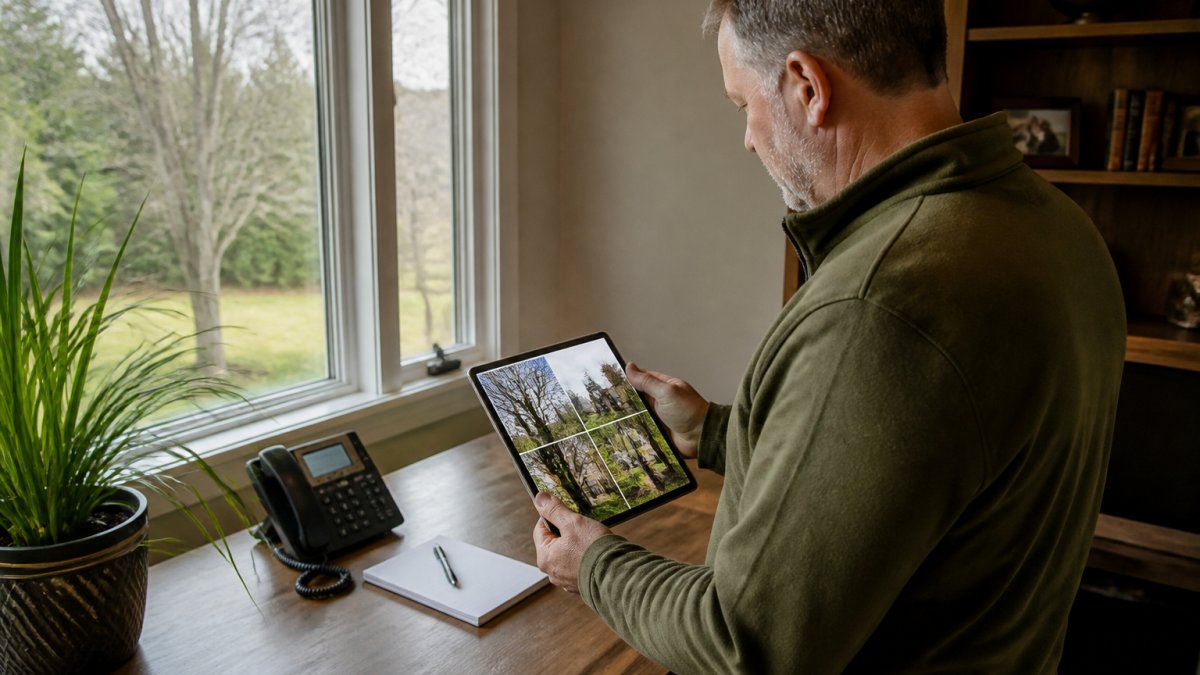
Name a local eyes-on contact if you have one: a property manager, tenant, or neighbor willing to confirm the crew arrived and left. It is not supervision, but it closes the biggest gap distance creates.
Handling Permits, Property Lines, and Local Rules From Afar
Tree removal rules vary by county and municipality, and some jurisdictions require a permit before removing certain protected or heritage species. Others regulate work in the public right-of-way or on parkway trees between the sidewalk and curb. Confirm in writing who files the permit and who pays the fee.
Property lines are the other trap. Hire a surveyor or pull the plat map before authorizing any removal near a boundary, and get a neighbor's written acknowledgment if a tree straddles the line. Confirm the company actually works your county before you hire it.
Planning a Seasonal Maintenance Calendar for Your Absentee Property
A calendar beats a crisis. Schedule an inspection in early spring to catch dead, dying, or diseased trees before storm season, a mid-summer walk for pruning and brush clearing, and a fall review focused on defensible space and wildfire risk reduction around structures. Add a post-storm inspection after any named weather event.
For vacant parcels, add brush clearing and mulching on a set cadence so overgrowth never becomes an emergency. A standing maintenance plan also gives you a documented history of care, which helps with insurers and with any liability question down the road.
Booking Your Remote Tree Service Consultation
You've got the vetting checklist, the insurance requirements, and the documentation plan. The remaining step is a conversation with a crew that already works absentee properties and can put the whole scope in writing. Redbird Tree Service brings over 25 years of field experience, certified arborists, and full certification and insurance to its work. Reach out through our contact page to request a written estimate and get your property on a maintenance schedule.
Frequently Asked Questions
How do I hire tree services for a property I can't visit?
Start by requesting a written estimate that includes a scope of work, photos of the trees in question, and a line-item breakdown. Ask for proof of insurance and arborist credentials, then confirm the crew will send before and after photos. Set up a single point of contact and agree on a payment schedule tied to milestones rather than paying the full amount upfront.
How can I verify a tree service's license and insurance remotely?
Ask the company to email a current certificate of insurance listing general liability and workers' compensation coverage, plus the policyholder name and expiration date. Call the insurer's number on the certificate to confirm it is active. For credentials, request the arborist's certification number and verify it through the certifying body's online directory. Keep copies for your property manager or insurer.
What should a tree removal estimate include?
A complete estimate names the trees to be removed or pruned, specifies whether stumps are ground, describes cleanup and debris hauling, states whether a permit is required and who files it, and lists the total price with any exclusions. Ask for the crew size, estimated timeline, and whether the quote accounts for access limitations such as fences or tight driveways. Get it in writing before work begins.
Can I authorize tree work without being on the property?
Yes. Most companies accept a signed estimate and written authorization by email, along with a deposit. Confirm who will be on site to provide access, whether a lockbox or gate code is needed, and how the crew will reach you with questions. Ask for the name of the on-site supervisor and a phone number so you can approve any change orders remotely.
What should I do if a tree is an immediate safety hazard?
If a tree is leaning toward a structure or has cracked limbs after a storm, treat it as urgent. Call a tree service that offers 24/7 emergency response, describe the situation, and send photos from your phone. Keep people and vehicles away from the area, and document the hazard with dated photos for your insurance company in case damage occurs before the crew arrives.
How do I confirm a tree service completed the work?
Require before and after photos of every tree addressed, plus a short written completion report noting what was removed, what was pruned, and how debris was handled. Compare the photos against the original estimate line by line. For larger jobs, ask for a final walkthrough video. Hold the last payment until you have reviewed the documentation and confirmed the site is clean.
Distance doesn't have to mean guesswork. If you own property you can't visit every month, the fix is a documented process and a crew that reports back in writing. Redbird Tree Service provides certified arborists, 24/7 emergency tree services, and full insurance documentation so out-of-state owners can authorize work with confidence. Get started with Redbird Tree Service and put your property on a maintenance plan you can actually verify from anywhere.