 how-to
How Do You Spot a Hazardous Leaning Tree?
Last Updated: November 2, 2026
Quick Summary
You spot hazardous leaning trees by checking the lean against nearby verticals, looking for fresh soil cracks, heaving or a lifted root plate, and scanning the trunk for splits, cavities and mushrooms. A new or worsening lean paired with ground movement is the key warning sign. Inspect from at least one tree length away and never stand under the tree.
- A tree that has leaned the same way for decades is usually fine, but a lean that appeared last week is not.
- Run the ground-level checklist from at least one tree length away to decide whether a professional is needed.
- Get people, pets and vehicles out of the drop zone, then call for help if a tree is cracked, uprooted or resting on a structure.
- Two or more root warning signs together mean stop and call someone.
- A cavity plus a lean plus a target like a roof is when we recommend a real assessment.
Table of Contents
- Start With a Hazard Tree Assessment You Can Do Safely
- When to Worry About a Leaning Tree
- Tree Root Damage Signs at the Base
- Trunk, Branch, and Canopy Defects That Signal Failure
- How to Find an Arborist Near Me for a Real Risk Assessment
- Schedule a Hazardous Leaning Tree Inspection
- Frequently Asked Questions
Start With a Hazard Tree Assessment You Can Do Safely
A hazardous tree is one with a defect that could cause it to fail and hit something worth protecting. Learning how to identify hazardous leaning trees starts with your eyes and your feet, not a chainsaw.
You can spot most serious problems in fifteen minutes. Walk the property. Look up, look down, and look at the base. The goal is not to diagnose the tree.
The Step-by-Step Inspection Checklist
Run this checklist from the ground, at least one tree length away:
- Check the lean angle against nearby verticals like fence posts or walls
- Look for soil cracks, heaving, or a raised mound on one side of the base
- Scan the trunk for splits, seams, and open cavities
- Look for dead or hanging branches in the canopy
- Note mushrooms or conks growing on the trunk or roots
- Check whether the canopy is sparse or lopsided
- Watch for new cracks in pavement or foundations nearby
- Photograph anything odd so you can compare it later
Write down the date of each photo. That record is how you tell a slow change from a sudden one.
What to Do Immediately If a Tree Looks Unstable
Get people and pets away from the drop zone first. Move vehicles and anything you value out from under the canopy.
Then call for help. If a tree is cracked, uprooted, or resting on a structure, that is an emergency. Professional arborists can assess the risk before anyone touches the tree.
Run this ground-level checklist from at least one tree length away to decide whether a professional is needed.
| Step | What to check |
|---|---|
| 1 | Lean angle against nearby verticals like fence posts or walls |
| 2 | Soil cracks, heaving, or raised mound on one side of base |
| 3 | Trunk splits, seams, and open cavities |
| 4 | Dead or hanging branches in the canopy |
| 5 | Mushrooms or conks on the trunk or roots |
| 6 | Canopy that is sparse or lopsided |
| 7 | New cracks in pavement or foundations nearby |
| 8 | Photograph anything odd and write down the date |
When to Worry About a Leaning Tree
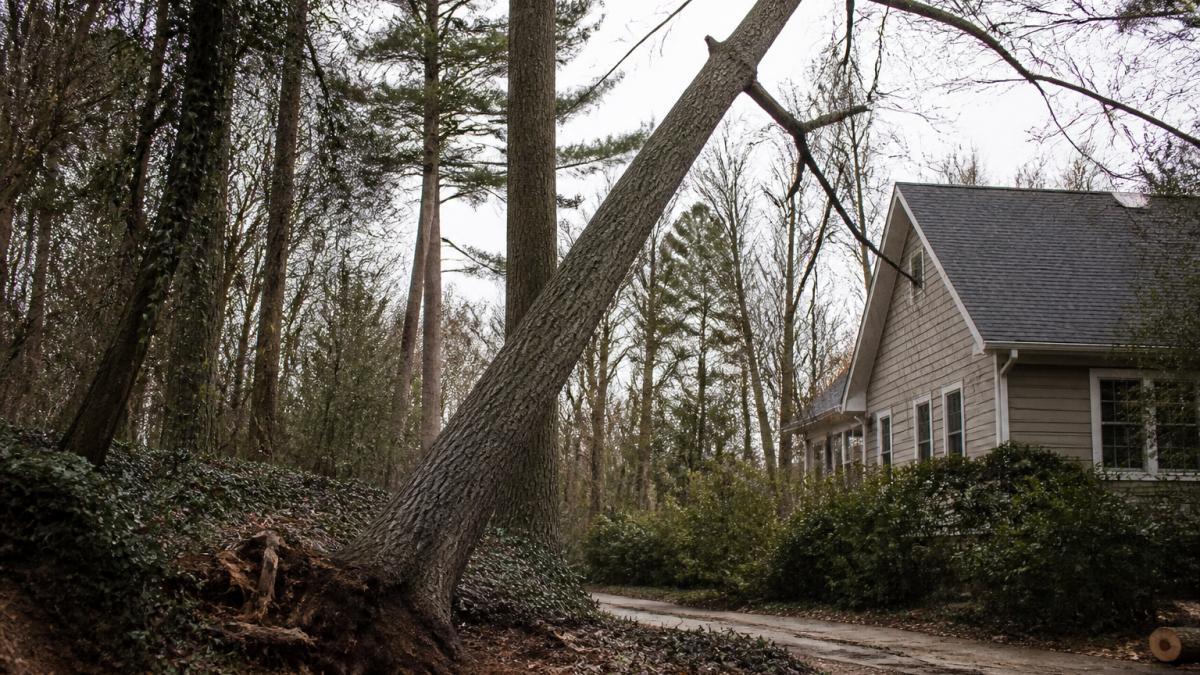
Worry when the lean is new, getting worse, or paired with ground movement. A tree that has leaned the same way for decades is usually fine. A tree that leaned last week is not.
The single most useful question you can ask is simple: has this changed? Compare old photos, ask neighbors, and check whether the lean has shifted since your last look.
Natural Lean vs. New Lean
Natural lean develops slowly as a tree grows toward light. The trunk usually curves, and the wood grows thicker on the tension side to hold the weight. The root plate stays flat and undisturbed.
New lean appears fast, often after a storm or heavy rain. Watch for these signs:
- Fresh soil cracks or a lifted root plate on the opposite side
- A straight trunk that suddenly sits at an angle
- Exposed roots pulled out of the ground
- A gap opening where the trunk meets the soil
A new lean on a big tree near a house is a call-now situation. Once a lean looks risky, a professional assessment is the safest next step, because a leaning tree can fall in an unpredictable direction. You can review Tree Removal Services and book the service.
Tree Root Damage Signs at the Base
Root problems are the hardest to see and the most dangerous to ignore. Roots fail underground before the trunk ever shows a crack.
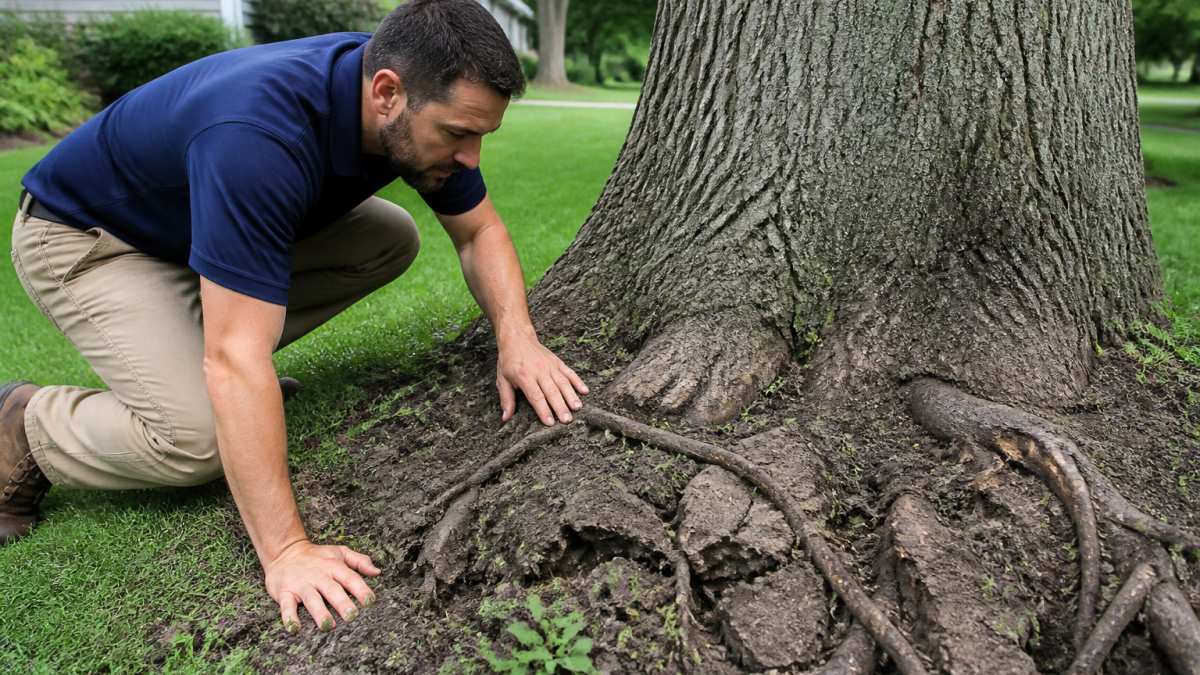
Look for these warning signs at the base:
- Soil heaving or a mound lifting on one side
- Cracks in the soil radiating out from the trunk
- Exposed roots that were previously buried
- Soft, spongy ground near the trunk after rain
Any one of these means the root plate may be losing grip. If base and root symptoms make you wonder whether disease is involved, a certified arborist can help you sort root rot and decay from simple storm damage. Common Signs Of Tree Disease In Kissimmee Fl helps readers tell whether base and root symptoms point to disease.
Trunk, Branch, and Canopy Defects That Signal Failure
Structural defects in the wood itself are the clearest warning signs a tree gives. Learn to read them and you will spot trouble early.
Check the trunk and branches for:
- Cracks and splits running up the trunk, especially fresh ones
- Cavities and hollows where water collects and wood decays
- Weak branch unions where two limbs meet with bark trapped between them
- Included bark, a seam of bark pressed into the crotch of a branch
- Dead or hanging branches that can drop without warning
A cavity alone does not mean removal. If you spot these defects, a certified arborist can diagnose the problem and recommend next steps before it becomes a removal. Tree Health Care Services can diagnose and treat the problem.
How to Find an Arborist Near Me for a Real Risk Assessment
A real risk assessment weighs two things: how likely the tree is to fail, and what it would hit if it did. That is called likelihood of failure versus target. A big dead oak in an empty field is low risk.
Visual inspection has limits. You cannot see internal decay, root spread, or how much sound wood is left inside a trunk. That is why a certified arborist uses training and, when needed, tools to look deeper.
When you search for an arborist near me, ask three questions:
- Are you certified and insured, and can I see documentation?
- Will you assess the tree and explain what could be saved?
- What is the risk if we wait?
A good arborist will tell you when a tree can be saved. You can contact our team to request an assessment and get answers before you decide anything.
Schedule a Hazardous Leaning Tree Inspection
Trees do not warn you twice. A new lean, a cracked trunk, or a lifted root plate is the tree telling you something has changed.
If you have a tree you are unsure about, do not wait for the next wind event. Redbird Tree Service offers 24/7 emergency tree services from certified arborists, backed by over 25 years of field experience.
Contact Redbird Tree Service to restore safety to your property.
Frequently Asked Questions
How can you tell if a leaning tree is hazardous?
A hazardous leaning tree shows recent movement plus a structural defect. Look for fresh soil heaving or cracking on the high side of the lean, exposed roots, a lean angle that has changed since you last saw the tree, and cracks or cavities in the trunk. A tree that has leaned the same way for years with a full canopy and stable soil is usually lower risk. Any sudden lean, especially after a storm, warrants a professional hazard tree assessment.
Can a tree lean naturally and still be safe?
Yes. Many trees grow with a natural lean toward sunlight and correct themselves over decades, building reaction wood that holds the angle. The difference is time and stability: a natural lean develops slowly, the soil around the base stays intact, and the canopy stays balanced. A new lean appears quickly, often after wind or root disturbance, and usually comes with soil cracking or exposed roots. When you are unsure which one you are looking at, have a certified arborist confirm it.
What are the warning signs of tree root damage?
Tree root damage signs include soil heaving or mounding on one side of the trunk, cracks in the ground radiating from the base, exposed roots that were previously buried, and a root plate that looks lifted. Mushrooms or conks at the base can also point to decay below ground. Because roots sit out of sight, these surface signals are your best early warning, and they are the main reason a leaning tree with disturbed soil should be assessed quickly.
Should I call an arborist about a leaning tree?
Call a certified arborist if the lean is new, the soil at the base is cracked or heaved, you see trunk cracks, cavities, or dead hanging branches, or the tree could hit a house, driveway, or power line if it fell. An arborist can measure the lean, check for internal decay, and tell you whether pruning, cabling, or removal is the right call. Redbird Tree Service offers 24/7 emergency response for trees that look ready to come down.
A leaning tree over your home is not a wait-and-see problem. Redbird Tree Service brings certified arborists, full insurance, and 24/7 emergency response to every call in Central Florida. We assess the tree, explain your options, and handle the cleanup so nothing is left behind. Get started with Redbird Tree Service and make your landscape safe again.